
How Orbital Installations Automated ECS Preview Environments
Each pull request received an isolated test URL, automated updates, and cleanup before production promotion.
About the Customer
Orbital Installations LLC provides construction and installation management software to mid-market and enterprise customers. Its product team needed to review several changes in parallel and release frequently without making a shared test environment the delivery bottleneck.
Problem Statement
Orbital Installations lacked isolated environments for testing pull requests, so concurrent feature reviews competed for shared environments. Deployments required significant DevOps involvement and took 2-3 hours, while infrastructure changes were spread across AWS Console operations, CloudFormation templates, and manual scripts. The team needed a reproducible AWS foundation, short-lived preview environments, automated production delivery, and reliable cleanup without leaving unused resources running.
CLIENT
Orbital Installations LLC
PROJECT SCHEDULE
Jan 2025 to Apr 2025
PROJECT SIZE
$200,000 to $499,999
Proposed Solution
Multi-Cluster ECS Architecture
Separate Amazon ECS clusters isolated development and production. AWS Fargate tasks ran in private subnets across multiple Availability Zones and scaled with workload demand.
Infrastructure as Code with Terraform
VPCs, subnets, security groups, ECS clusters, and load balancers were moved into modular Terraform stored in Git. This replaced the mix of console operations and manual scripts with a reviewable source of truth.
GitHub Actions CI/CD with PR Preview Environments
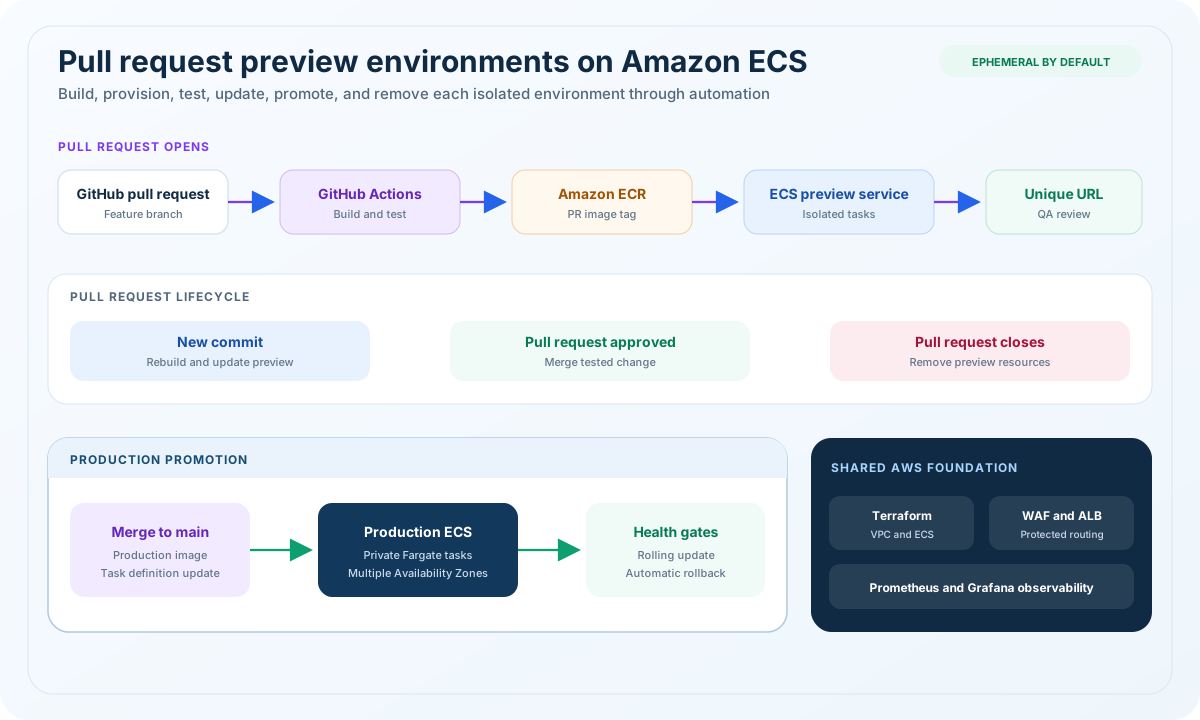
When a pull request opens, GitHub Actions builds a Docker image, publishes it to Amazon ECR, creates an isolated ECS service, and returns a unique URL for focused review and QA.
Automated Preview Environment Management
Preview environments update when new commits are pushed. When a pull request closes or merges, the workflow removes its ECS service and associated resources to limit idle cost.
Production Deployment Automation
Merges to the main branch build a production image, update the ECS task definition, and start a controlled deployment with health checks and automated rollback.
Comprehensive Monitoring with Prometheus and Grafana
Prometheus collected metrics from ECS tasks and Grafana dashboards showed service health and application performance for preview and production environments.
Secure Network Architecture
ECS tasks ran in private subnets and used VPC endpoints for AWS service access. Public Application Load Balancers used AWS WAF and TLS certificates from AWS Certificate Manager for protected inbound traffic.
The workflow treated each pull request as a complete lifecycle: build, provision, test, update, approve, promote, and remove. Terraform kept the shared AWS foundation reproducible while automation controlled the short-lived services.
Core tech stack we work with
Leveraging the Leading Programming Languages and Frameworks to Deliver Reliable, Scalable Solutions.


Outcomes & Success Metrics
Measurable improvements in performance, reliability, scalability, and cost.
Results and Benefits
Pull request review time decreased from 2-3 days to approximately 8-10 hours after QA could test each change at its own URL. Deployment frequency increased from 2-3 to 8-10 releases per week, and the full production pipeline reduced deployment time from 3-4 hours to under 40 minutes.
Terraform reduced environment provisioning from several days to under 30 minutes for the measured workflow. Automated teardown also removed preview services after pull requests closed, limiting orphaned resource cost.
Deployment-related production incidents decreased from 8-10 per quarter to 2-3. Mean time to recovery improved from more than 40 minutes to 12-15 minutes through health checks and automated rollback. The preview workflow also moved more testing before merge, when changes were easier to isolate and correct.
Need isolated preview environments on AWS?
We can review your current pull request workflow, ECS architecture, cleanup controls, and production release path and identify a practical pilot.
Review my preview workflow