
How AI is changing DevOps
Separate faster task completion from delivery outcomes, then measure the added change volume, review demand, risk, and operating cost.
Read the guideCodetoKloud designs, migrates, secures, and manages production Kubernetes on Amazon EKS, GitOps with ArgoCD, Helm, autoscaling, observability, and cost optimization from an AWS Advanced Tier Partner.
 AWS Advanced Tier Partner★ 4.9/5 on Clutch (9 reviews)Replies within 1 business day
Kubernetes consulting is expert help designing, deploying, securing, and operating Kubernetes, the platform that automates running containerized applications at scale. CodetoKloud, an AWS Advanced Tier Partner, provides Kubernetes consulting on Amazon EKS: cluster design, GitOps delivery, autoscaling, observability, cost optimization, and ongoing managed operations.
Whether you are launching your first cluster, migrating existing workloads to Amazon EKS, or trying to control a Kubernetes bill that is growing faster than your traffic, we bring the production experience to improve the operating model and implement technical controls for regulated workloads where required.
End-to-end Kubernetes engineering, from first cluster to day-2 operations, built on Amazon EKS.
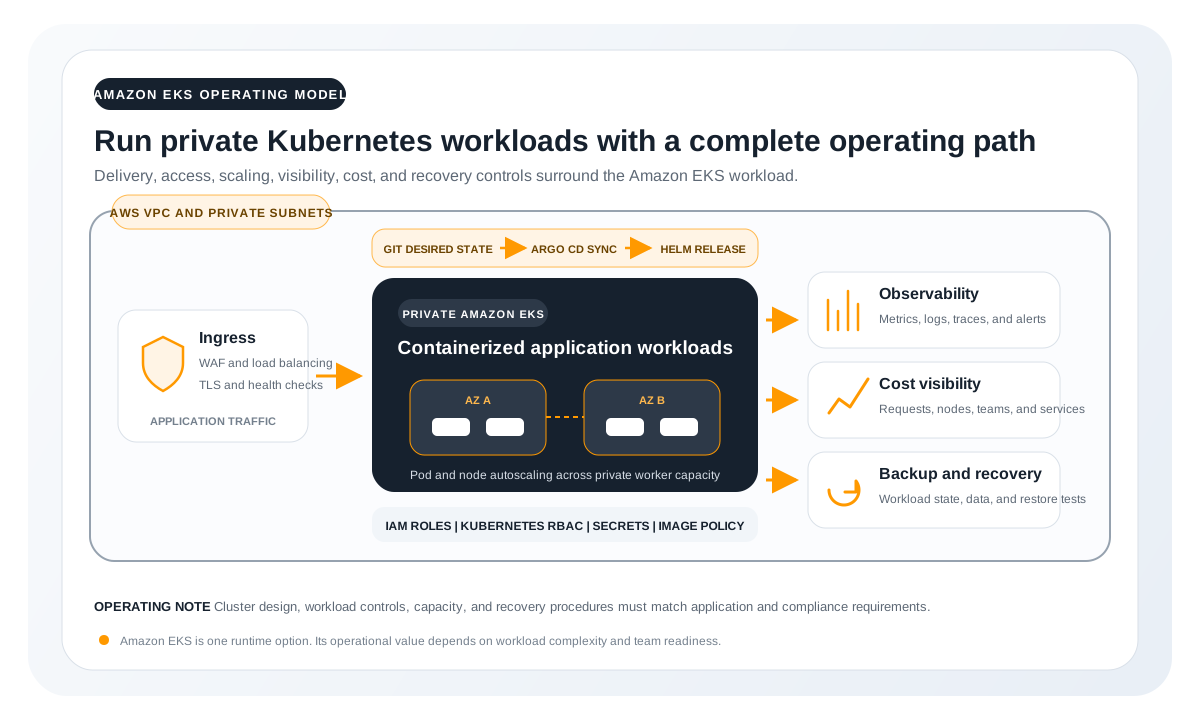
We architect Amazon EKS clusters with managed node groups, private networking, and separate development, staging, and production environments. The design integrates AWS IAM, VPC networking, CloudWatch, and the operating controls your team needs.
We implement GitOps with ArgoCD so your cluster's desired state lives in Git and syncs automatically. Every change is versioned, reviewable, and auditable. On one client pipeline this reduced manual deployment effort by 80% and made releases 50% faster.
We package applications as Helm charts to manage configuration, versioning, and repeatable releases across environments, making deployments consistent, easy to roll back, and simple for your team to maintain.
We tune horizontal pod autoscaling, cluster autoscaling, and modern autoscalers like Karpenter so your workloads scale with demand and you only pay for the capacity you use.
We add full observability with Prometheus, Grafana, Datadog, and CloudWatch, metrics, logs, traces, dashboards, and alerting, so you catch issues early and keep mean time to recovery low.
We reduce Kubernetes spend by right-sizing pod requests, tuning node groups, using Spot capacity, and consolidating idle workloads. On a healthcare EKS migration this approach cut cloud costs by roughly 35%.
We harden clusters with least-privilege RBAC, IAM roles for service accounts, network policies, encrypted secrets, image scanning, and continuous monitoring. These controls can support the technical scope of SOC 2, HIPAA, and PCI DSS programs on AWS.
We migrate applications from virtual machines, on-premises servers, or other container platforms to Kubernetes on Amazon EKS, including containerization, CI/CD, and low-downtime cutover. A recent migration cut API latency from 850ms to 320ms.
We run ongoing Kubernetes operations, version and node upgrades, patching, monitoring, autoscaling tuning, incident response, and disaster recovery, so your platform stays secure, current, and reliable after launch.
The three main ways to run containers on AWS, and when each fits. Not sure which is right for your workload? We help teams choose.
| Option | What it is | Best for |
|---|---|---|
| Amazon EKS | Managed Kubernetes on AWS, with the full Kubernetes ecosystem (Helm, ArgoCD, operators). | Portability, complex or growing platforms, teams standardizing on Kubernetes. |
| Amazon ECS | AWS-native container orchestrator that is simpler than Kubernetes to adopt and operate. | Straightforward workloads, smaller teams, faster time to production on AWS. |
| AWS Fargate | Serverless compute for containers, runs EKS or ECS pods without managing servers. | Removing node management, variable or spiky workloads, minimizing ops overhead. |
Production Kubernetes, GitOps, and control assessment work across cloud and on-premise environments.
Migrated a healthcare workforce platform to Amazon EKS with GitOps, autoscaling, and technical safeguards for regulated workloads.
Built an automated CI/CD pipeline using ArgoCD, Helm, and Amazon EKS across dev, staging, and production environments.
Deployed FusionPBX on Kubernetes with a Python-based AI service for real-time scam-call detection and high availability.
Migrated a SaaS application to modern AWS infrastructure with container orchestration, CI/CD, and full monitoring.
Built a four-node RKE2 platform with two control-plane nodes, two GPU workers, self-hosted observability, and an operational handoff for a company preparing for multiple frameworks.
Assessed AWS EKS and Linode LKE environments control by control, documenting shared responsibility and collecting cluster evidence with kube-bench where available.
Engineering guides
Use AI to assist with evidence, review, and troubleshooting while GitOps, policy checks, limited identities, and production approvals constrain the blast radius.
Separate faster task completion from delivery outcomes, then measure the added change volume, review demand, risk, and operating cost.
Read the guideUse deterministic validation, policy checks, plan review, approval gates, staged deployment, and rollback for Terraform and Kubernetes changes.
Read the guideStart with evidence gathering and recommendations, then define the production actions that still require explicit human approval.
Read the guideLimit agent permissions, protect secrets, isolate execution, enforce deterministic security checks, and retain a human production gate.
Read the guideTell us about your clusters, cloud spend, and operating concerns. We will confirm fit within one business day and use a focused 30-minute review to identify three practical priorities.
Book a Kubernetes readiness reviewCommon questions about Kubernetes and EKS consulting, migration, cost, and security.
Kubernetes is an open-source platform that automates the deployment, scaling, and management of containerized applications. Businesses use it to run applications reliably across many servers, scale automatically with demand, recover from failures without downtime, and ship updates safely. CodetoKloud designs and operates production Kubernetes clusters for companies that need this level of scalability and resilience.
Amazon EKS (Elastic Kubernetes Service) is AWS's managed Kubernetes service, which runs the Kubernetes control plane for you so your team focuses on applications instead of cluster infrastructure. It is the right choice when you want Kubernetes on AWS with deep integration into services like IAM, VPC networking, and CloudWatch. As an AWS Advanced Tier Partner, CodetoKloud specializes in EKS cluster design, managed node groups, and day-2 operations.
CodetoKloud's Kubernetes consulting covers cluster architecture and setup on Amazon EKS, GitOps delivery with ArgoCD, Helm-based application packaging, horizontal and cluster autoscaling, observability with Prometheus, Grafana, Datadog, and CloudWatch, cost optimization, security hardening, and ongoing managed operations including version upgrades and disaster recovery.
Amazon EKS is best when you need full Kubernetes portability, a rich ecosystem (Helm, ArgoCD, operators), or already run Kubernetes elsewhere. Amazon ECS is a simpler AWS-native container orchestrator that is faster to adopt for straightforward workloads. AWS Fargate is a serverless compute engine that runs containers for either EKS or ECS without managing servers. CodetoKloud helps teams choose based on portability needs, team skills, and operational overhead, and has delivered both ECS and EKS platforms in production.
CodetoKloud reduces Kubernetes costs by right-sizing pod requests and limits, tuning cluster autoscaling and node groups, using Spot instances and modern autoscalers like Karpenter, consolidating underused workloads, and adding cost visibility. On a healthcare workload migrated to Amazon EKS, this approach cut cloud costs by roughly 35% while improving reliability.
CodetoKloud secures Kubernetes clusters using private networking, least-privilege RBAC and IAM roles for service accounts, network policies, encrypted secrets management, image vulnerability scanning, and continuous monitoring. This DevSecOps approach lets clusters support regulated workloads, including SOC 2, HIPAA, and PCI DSS requirements on AWS.
GitOps is a delivery model where the desired state of your Kubernetes environment is stored in Git and automatically synced to the cluster, so every change is versioned, reviewable, and auditable. CodetoKloud implements GitOps with ArgoCD and Helm. On one client pipeline, this reduced manual deployment effort by 80% and made releases 50% faster.
Yes. CodetoKloud plans and executes migrations from virtual machines, on-premises servers, or other container platforms to Kubernetes on Amazon EKS, including containerization, Helm packaging, CI/CD and GitOps setup, and cutover with minimal downtime. A recent EKS migration cut API latency from 850ms to 320ms and reached 99.7% uptime.
Kubernetes can support regulated workloads when the cluster is configured with private networking, encryption, access controls, audit logging, and monitoring. CodetoKloud implements these technical safeguards on Amazon EKS for healthcare and other regulated teams. HIPAA and SOC 2 readiness also depends on organizational policies, operating procedures, risk management, and independent legal or audit review.
Yes. CodetoKloud offers managed day-2 Kubernetes operations, including cluster and node version upgrades, patching, monitoring and alerting, autoscaling tuning, incident response, and disaster recovery, so your platform stays secure, current, and reliable after the initial build.
Compare focused compliance services and choose the next step for your AWS environment.