
AI Use Case and Feasibility Review
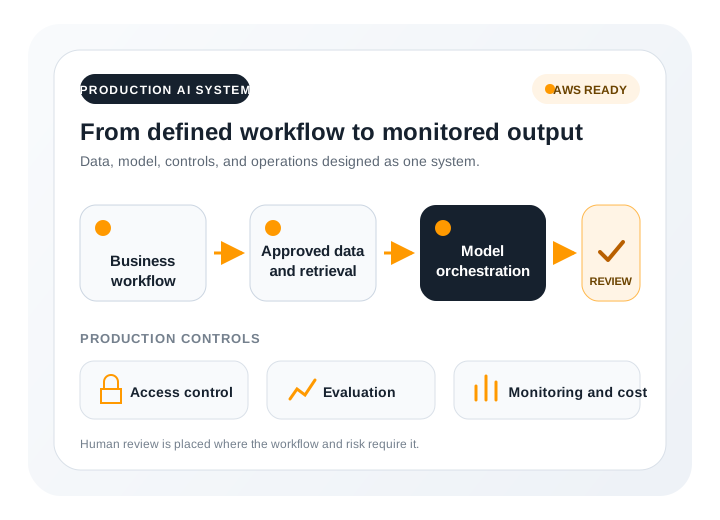
We define the workflow, users, source data, quality threshold, risks, and business measure before recommending a model or platform.
CodetoKloud turns a defined business workflow into a secure AI application, from data preparation and retrieval to model integration, evaluation, deployment, and monitoring.
 AWS Advanced Tier Partner★ 4.9/5 on Clutch (9 reviews)Replies within 1 business day
AI engineering turns a defined workflow into a dependable software system. That includes preparing data, selecting and evaluating models, connecting business systems, controlling access, monitoring quality, and operating the application after launch.
CodetoKloud focuses on bounded use cases with a clear user, approved data, measurable quality criteria, and a responsible human decision point where one is needed. We will also say when rules-based automation or better search is a more reliable fit than generative AI.
Each engagement connects the model to the data, controls, integrations, and operating practices required for production use.
We define the workflow, users, source data, quality threshold, risks, and business measure before recommending a model or platform.
We build retrieval pipelines that connect approved business content to an AI application, with source attribution and access rules designed around your data.
We connect AI to existing APIs and business systems for bounded tasks such as document intake, classification, summarization, and assisted decision support.
We compare model options against representative examples, then track response quality, latency, failure modes, and operating cost before launch.
We design authentication, authorization, data handling, prompt controls, output checks, audit logs, and human review for higher-risk actions.
We deploy the application with repeatable infrastructure, monitoring, release automation, and clear operating documentation for your team.
The process is designed to test value and risk early, before a larger implementation commitment.
We identify the user, current process, expected output, approval boundary, and measurable result. A focused first use case creates a clearer path to production.
We review data access, privacy, integration points, model choices, expected usage, and evaluation criteria before committing to a build.
We implement the smallest end-to-end workflow and test it against realistic cases, including known failure scenarios and unacceptable outputs.
We add security, monitoring, deployment automation, cost controls, documentation, and a handoff plan so the system can be operated responsibly.
A production example combining an AI service with cloud infrastructure, delivery automation, and observability.
Bring the process, sample inputs, desired output, and constraints. We will help you identify the fastest responsible way to validate the use case.
We choose model, retrieval, machine learning, and AWS services after evaluating data, quality, privacy, latency, and cost requirements.






Engineering guides
These guides cover where AI changes DevOps work, how to review generated infrastructure, and which security and production controls still need deterministic enforcement.
Separate faster task completion from delivery outcomes, then measure the added change volume, review demand, risk, and operating cost.
Read the guideUse deterministic validation, policy checks, plan review, approval gates, staged deployment, and rollback for Terraform and Kubernetes changes.
Read the guideStart with evidence gathering and recommendations, then define the production actions that still require explicit human approval.
Read the guideLimit agent permissions, protect secrets, isolate execution, enforce deterministic security checks, and retain a human production gate.
Read the guidePractical answers about use cases, model selection, data privacy, and production readiness.
CodetoKloud builds focused AI applications such as internal knowledge assistants, document processing workflows, classification and extraction services, and AI features within existing software. We start with a defined business workflow and only recommend AI when the data, quality threshold, and operating model support it.
We compare suitable models using representative business examples, required accuracy, latency, privacy, integration effort, and operating cost. The decision is based on measured fit for the use case rather than a preferred vendor or the largest available model.
Yes, when the selected architecture and model option support that requirement. We can keep application data, retrieval indexes, logs, and supporting services in your AWS account, apply least-privilege access, and document any external model endpoints that remain in the data path.
A production AI system needs repeatable evaluations, access controls, output guardrails, monitoring, cost limits, failure handling, deployment automation, and an owner for ongoing review. We include those operating requirements in the design instead of treating the model response as the finished product.
A useful first review needs the current workflow, intended users, representative inputs and outputs, relevant data sources, privacy constraints, integration points, and a measurable definition of success. We can help refine those inputs during discovery.