
Delivery and Operations Assessment
We review the path from code change to production, infrastructure ownership, release failures, recovery steps, environments, access, monitoring, and current operating constraints.
CodetoKloud improves how teams build, release, and operate software on AWS through CI/CD pipelines, infrastructure as code, GitOps, containers, observability, and practical DevSecOps controls.
 AWS Advanced Tier Partner★ 4.9/5 on Clutch (9 reviews)Replies within 1 business day
DevOps consulting is expert help improving the system that moves software from a code change into reliable production operation. It connects delivery automation, cloud infrastructure, release controls, observability, security, and team ownership so releases become repeatable and recoverable.
CodetoKloud provides DevOps consulting for AWS environments using CI/CD, Terraform or CloudFormation, GitOps, Amazon ECS, Amazon EKS, and production observability. We start from the delivery constraint and operating model, not from a requirement to adopt a particular tool.
The engagement connects automation with the controls, visibility, and team ownership needed to use it safely in production.
We review the path from code change to production, infrastructure ownership, release failures, recovery steps, environments, access, monitoring, and current operating constraints.
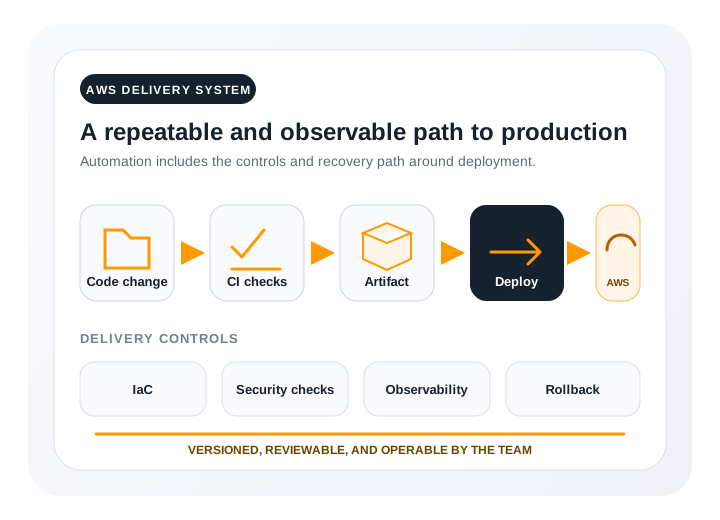
We build test, build, security check, approval, deployment, health verification, and rollback stages around the way your team releases software.
We define AWS infrastructure with Terraform or CloudFormation so environments are version-controlled, reviewable, repeatable, and less dependent on console changes.
We containerize applications and implement the appropriate AWS runtime, from ECS for simpler workloads to Amazon EKS when the Kubernetes ecosystem and portability are justified.
We connect service metrics, logs, traces, dashboards, alerts, health checks, and recovery procedures to the customer journeys and systems your team must protect.
We add least-privilege access, secrets handling, dependency and image checks, change evidence, runbooks, and documentation that your team can operate after delivery.
We baseline the current workflow first, then automate the highest-value path and transfer ownership in measurable stages.
We measure how a change reaches production, where work waits, what fails, how recovery happens, and which manual steps or access paths create the most risk.
We agree on environments, branching and release rules, infrastructure ownership, approvals, security checks, deployment strategy, rollback, and observable success criteria.
We implement the highest-value path first, test it with representative services, and expand only after the team can see and operate the new workflow.
We provide runbooks, diagrams, code ownership, operating guidance, and a prioritized backlog based on delivery performance and reliability evidence.
Examples of CI/CD and cloud automation engagements with results documented in the full case studies.
CodetoKloud implemented an automated pipeline across development, staging, and production environments with GitOps reconciliation and repeatable Helm releases.
CodetoKloud used GitHub Actions and Terraform to create isolated preview environments and automate the path from code change to Amazon ECS production deployment.
CodetoKloud connected GitHub Actions, Amazon ECR, Helm, ArgoCD, and External Secrets Operator into a controlled delivery path with automatic development sync and a manual production approval gate.
Bring the current release flow, toolchain, recent failure patterns, and desired outcome. We will help you identify the first automation or reliability change worth making.
We work with established delivery, infrastructure, container, GitOps, and observability tools, while keeping the workflow and ownership model more important than the tool list.





Engineering guides
Learn how AI changes delivery volume and review work, then apply practical controls to infrastructure changes, CI/CD agents, and incident response.
Separate faster task completion from delivery outcomes, then measure the added change volume, review demand, risk, and operating cost.
Read the guideUse deterministic validation, policy checks, plan review, approval gates, staged deployment, and rollback for Terraform and Kubernetes changes.
Read the guideStart with evidence gathering and recommendations, then define the production actions that still require explicit human approval.
Read the guideLimit agent permissions, protect secrets, isolate execution, enforce deterministic security checks, and retain a human production gate.
Read the guideAnswers about scope, tool choices, Kubernetes, DevSecOps, engagement models, and measuring delivery improvement.
A DevOps engagement can include delivery assessment, CI/CD pipelines, infrastructure as code, container platforms, GitOps, monitoring, release controls, secrets management, runbooks, and team handoff. The scope should target a defined constraint such as slow releases, frequent failures, infrastructure drift, or limited operational visibility.
Yes. We review whether the current Git provider, CI platform, cloud services, and monitoring tools can support the target workflow. We keep useful tools when practical and recommend a change only when a clear requirement, operating burden, or integration limit justifies it.
No. CI/CD, infrastructure as code, observability, and release controls apply to virtual machines, serverless services, Amazon ECS, and other runtimes. Kubernetes is appropriate when its scheduling, portability, ecosystem, and platform capabilities are worth the additional operational complexity.
We define least-privilege access, protected secrets, code review and approval rules, dependency and image checks, infrastructure policy checks, deployment evidence, and centralized logs according to workload risk and compliance requirements.
We select measures tied to the initial constraint, such as deployment lead time, deployment frequency, change failure rate, recovery time, manual effort, environment provisioning time, or alert quality. The baseline and target are agreed before implementation where reliable data is available.
Yes. CodetoKloud can deliver a defined automation or platform project, provide embedded engineering for a transformation, or support ongoing operations. Responsibilities, response expectations, access, and handoff criteria are defined for each engagement.