
AI for Cloud and Kubernetes Incident Response
Learn where AI can assist cloud and Kubernetes incident response, which production actions require approval, and how to measure safety and operational value.
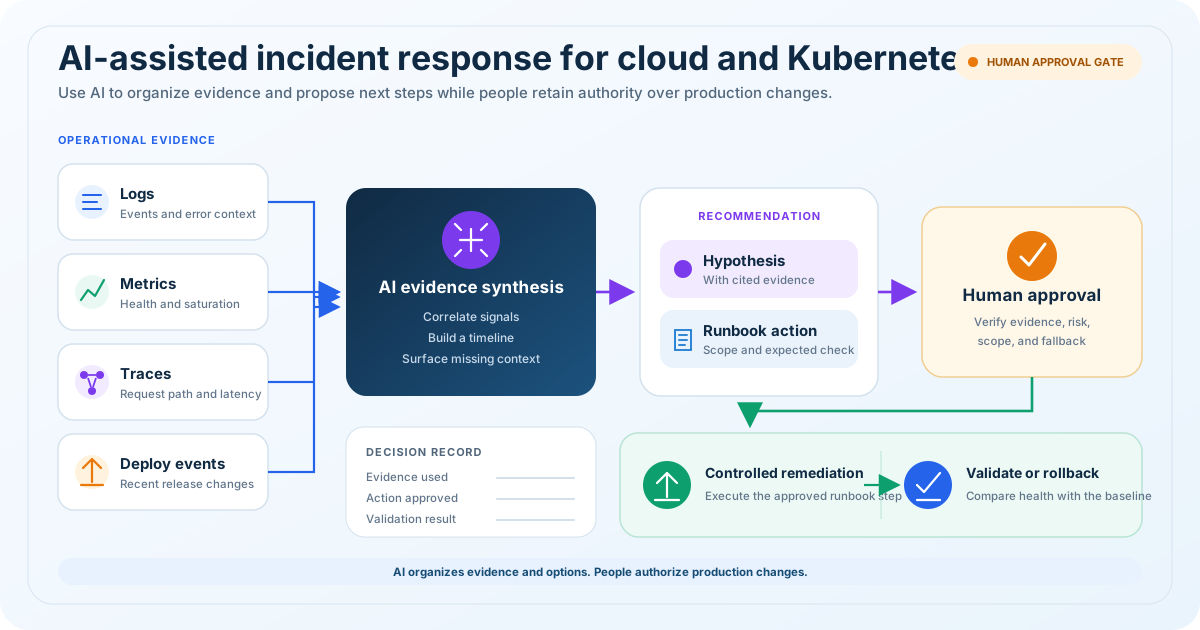
AI can make cloud and Kubernetes incident response faster by gathering evidence, correlating changes, proposing hypotheses, and preparing safe actions. It should not begin with unrestricted production access. The safest operating model is read-only first, evidence before explanation, explicit autonomy tiers, deterministic checks, and human approval for actions that can affect availability, security, or data.
That distinction matters. A useful incident assistant reduces the time engineers spend searching across dashboards and reconstructing timelines. An unsafe agent turns a plausible but unverified explanation into a production change. The goal is not to replace incident command. It is to give responders a better evidence package, clearer options, and controlled automation.
Why AI is changing incident response
Modern incidents cross several systems. A Kubernetes alert may be connected to a deployment, a cloud load balancer change, an expiring secret, a database constraint, or an upstream dependency. Responders often move between logs, metrics, traces, audit events, deployment records, Git history, cloud configuration, tickets, and runbooks before they can form a credible hypothesis.
AI is well suited to the search and synthesis part of that work. An assistant can normalize timestamps, group related alerts, summarize a deployment diff, identify which services sit on the failing request path, and retrieve a relevant runbook. AWS documents operational investigations that analyze logs, metrics, deployments, and configuration changes. Google SRE describes agents that use observability data alongside topology and dependency context before proposing mitigations.
The same capability introduces new risk. Model output is probabilistic. Incident inputs can be incomplete, stale, sensitive, or actively malicious. Production actions are often irreversible at the exact moment when system state is changing quickly. AI therefore increases both the speed of investigation and the need for stronger operational boundaries.
Teams building this capability should connect it to a mature DevOps operating model, reliable Kubernetes engineering, and clear security and compliance controls. AI cannot compensate for missing telemetry, unclear ownership, or unsafe deployment practices.
Start with an evidence package, not a root cause
An incident assistant should first assemble a timestamped evidence package. It should distinguish observed facts from model-generated hypotheses and preserve links to the original systems.
Useful evidence includes:
- Logs from the affected workload, ingress layer, service mesh, cloud control plane, and critical dependencies
- Metrics for latency, errors, traffic, saturation, queue depth, pod restarts, resource throttling, and dependency health
- Distributed traces that show the failing request path and where latency or errors begin
- Recent application, manifest, Helm, infrastructure, policy, and feature flag deployments
- Kubernetes events, rollout status, admission decisions, audit logs, and changes to ConfigMaps or Secrets
- Cloud configuration and identity events, including network, load balancer, database, and IAM changes
- Service ownership, topology, dependency maps, SLOs, escalation policy, and current incident roles
- Runbooks and prior incidents, including their version, owner, and last validation date
Every conclusion should cite the evidence that supports it. If the assistant says a rollout is correlated with an error increase, it should show the rollout time, the metric window, the affected versions, and any counterevidence. Correlation is not proof of causation. A good response uses language such as likely contributor, competing hypothesis, and evidence still required.
This is also why observability design comes first. The EKS GitOps microservices case study shows how health checks, environment-specific configuration, and controlled promotion create useful operational context. An AI layer can reason over those signals, but it cannot reconstruct evidence that the platform never recorded.
Use explicit autonomy tiers
Autonomy should be granted by action risk, not by how confident the model sounds.
Tier 0: retrieval and summarization
The system can search approved sources, collect telemetry, summarize the incident channel, build a timeline, and identify missing signals. It has read-only access and cannot change production. This is the right starting point for most organizations.
Tier 1: recommendations
The assistant can propose diagnostic queries and mitigation options. It must show evidence, expected impact, preconditions, validation steps, rollback steps, and uncertainty. A human runs the action through existing tools.
Tier 2: approved execution
The agent can prepare or execute a predefined action after an authorized responder approves the exact target and parameters. Examples might include replacing a single unhealthy pod managed by an existing controller or pausing a deployment, provided the action is already encoded, tested, scoped, and reversible.
Tier 3: bounded automation
The system can execute a narrow, preapproved response when deterministic conditions are met. It needs strict resource limits, an idempotency key, a timeout, a circuit breaker, post-action validation, and automatic escalation when the expected result does not occur.
Broad autonomous remediation across production should not be the default. Critical data operations, identity changes, network isolation, destructive commands, and multi-region failover generally deserve explicit human control. Each organization should define its own risk matrix based on workload criticality and regulatory obligations.
Design for the failure modes unique to AI
Confabulated root cause
An assistant can produce a coherent story that is not supported by the evidence. Prevent this by requiring source citations, separating facts from hypotheses, retrieving data from authoritative systems, and using deterministic queries to test each hypothesis. If evidence conflicts, the system should report the conflict rather than force a single answer.
Malicious instructions inside logs and tickets
Logs, alerts, pull request descriptions, tickets, chat messages, and runbooks are untrusted data. An attacker may place text in them that tells an agent to ignore policy, reveal a secret, call an external endpoint, or run a command. This is indirect prompt injection.
The agent must never treat retrieved content as control instructions. Tool policy belongs outside the model prompt. Allowlisted operations, schema validation, data classification, output filtering, and fixed authorization checks must govern what the system can read or do. Sensitive evidence should be redacted before it reaches a model when full values are unnecessary.
Stale or unsafe runbooks
A retrieved runbook may describe a resource that no longer exists or a command that is unsafe for the current topology. Store runbooks in version control, assign owners, record validation dates, test procedures in non-production environments, and expire documents that are not reviewed. The agent should compare a runbook's assumptions with live inventory before recommending it.
Excessive privilege
Do not reuse a platform administrator identity. Give the agent a distinct workload identity with least-privilege permissions, short session duration, resource and environment boundaries, and no standing access to secrets it does not require. Keep investigation access separate from remediation access. Record both the agent identity and the human approver in the audit trail.
NIST's Generative AI Profile emphasizes managing risks across the AI lifecycle, while the AWS Generative AI Lens calls for prompt security, agency controls, traceability, response validation, and comprehensive monitoring. Those controls belong in the platform architecture, not in a reminder appended to a prompt.
Make every production action predictable
AI may choose among approved actions, but the execution path should remain deterministic.
- Validate the target resource, environment, current version, incident identifier, and requested parameters against a strict schema.
- Recheck preconditions immediately before execution because production state may have changed since the recommendation was created.
- Use idempotency keys so retries do not duplicate an operation.
- Set a bounded timeout and a circuit breaker so a failed workflow cannot loop through production.
- Limit concurrency and blast radius by namespace, cluster, account, region, service, and resource count.
- Capture state before the action and define an explicit rollback or safe-stop path.
- Run deterministic post-action checks against health, SLO, error, and dependency signals.
- Stop and escalate when validation is inconclusive, the action exceeds its budget, or new symptoms appear.
For Kubernetes, this might mean preparing a Git revert or a declarative configuration change rather than issuing an unrecorded imperative mutation. A controlled GitOps approach provides review history, a desired-state record, and a clearer rollback path. The CIS Kubernetes assessment case study also illustrates why permissions, workload settings, network controls, and node configuration need to be evaluated as separate evidence domains.
Rollback is not simply another model suggestion. It should be an engineered procedure with a known target, compatibility checks, data migration considerations, and success criteria. Some changes cannot be safely reversed. In those cases, the approved response may be traffic shifting, feature isolation, or a forward fix.
A reference workflow for cloud and Kubernetes incidents
- An existing monitoring system opens an incident from an SLO or high-quality alert.
- A read-only agent gathers the relevant evidence for the affected time window and records provenance.
- The agent constructs a timeline and marks facts, gaps, hypotheses, and possible customer impact separately.
- Deterministic tools test the leading hypotheses using approved queries.
- The assistant retrieves only versioned, applicable runbooks and proposes ranked options.
- The incident commander selects an option. High-risk actions require a second authorized approver when policy requires it.
- A constrained executor validates identity, scope, preconditions, idempotency, timeout, and rollback readiness.
- Post-action checks compare the system against explicit success and stop conditions.
- The system records the evidence, prompt and model versions, tool calls, approvals, outputs, cost, and final disposition.
- A human reviews the incident record and updates runbooks, tests, alerts, or platform controls.
If the AI service is unavailable, responders must retain access to dashboards, runbooks, credentials, and standard incident tooling. Graceful degradation is a production requirement. Google SRE explicitly describes backup options, transparency, strong agent identities, evaluation, auditing, and contingency planning as design considerations for SRE AI.
Measure whether the system is actually helping
Do not declare success because summaries sound polished. Establish a baseline, evaluate on historical incidents and simulations, and compare assisted and unassisted workflows.
Track at least:
- Time to acknowledgement, from alert creation to responder ownership
- Time to triage, from acknowledgement to a supported problem scope and next action
- Time to recovery, using a definition aligned with service health and customer impact
- False suggestion rate, including recommendations rejected because evidence or scope was wrong
- Rollback rate for AI-recommended or AI-executed changes
- Approval override rate and reasons responders rejected a proposal
- Evidence coverage, provenance completeness, and citation accuracy
- Cost per incident, including model, retrieval, storage, and tool execution costs
- Unauthorized or out-of-policy action attempts, including attempts blocked by controls
Segment results by service, severity, incident type, autonomy tier, and model or prompt version. A lower triage time is not a win if false suggestions, rollbacks, or security exceptions rise. These are evaluation measures, not promised outcomes.
A practical adoption sequence
Begin with read-only summaries for a small set of well-instrumented services. Test the assistant against resolved incidents without letting it see the final diagnosis. Ask experienced responders to score evidence quality, relevance, unsafe recommendations, and missing alternatives.
Next, add recommendation mode with approved diagnostic tools. Introduce execution only for a short list of reversible procedures that already work reliably without AI. Run game days that include misleading telemetry, prompt injection in logs, unavailable models, stale runbooks, partial tool failure, duplicate requests, and failed rollback.
Finally, review identity, data handling, retention, model access, and audit evidence with security and compliance owners. Teams that need help establishing those foundations can start with cloud consulting and advisory or a focused Kubernetes consulting engagement.
Frequently asked questions
Should an AI agent have cluster-admin access?
No. Use a distinct identity with the minimum permissions required for a specific tier and environment. Separate read-only investigation from approved remediation.
Can AI determine the root cause of a Kubernetes incident?
It can propose and test hypotheses, but its conclusion must be supported by cited evidence and deterministic validation. Uncertainty and competing explanations should remain visible.
What incident data can be sent to a model?
Only data allowed by the organization's classification, privacy, residency, retention, and vendor policies. Redact secrets and unnecessary personal or customer data before model access.
Which remediation actions are safest to automate first?
Choose narrow, reversible, well-tested, idempotent actions with explicit preconditions, timeouts, validation, and rollback. Avoid destructive or broad-scope actions.
How should teams test an incident response agent?
Use historical incidents, controlled simulations, adversarial inputs, stale documentation, tool failures, and recovery drills. Evaluate factual support, safety, policy compliance, and operational value.
Sources and further reading
- Google Cloud: How Google SRE is using agentic AI to improve operations
- AWS: Monitoring investigations with Amazon Q Developer
- AWS Well-Architected Generative AI Lens: Generative AI-assisted incident response system
- NIST: Artificial Intelligence Risk Management Framework Generative Artificial Intelligence Profile
Strengthen your cloud incident operating model
Review the telemetry, permissions, runbooks, approval boundaries, and recovery controls required before AI assists production response.